Tangent Space and the TBN Basis
a little frame at every point that lets normal maps travel
Tangent follows +U, bitangent follows +V, normal points out. The [T B N] matrix turns a normal-map sample into a world normal, whatever the mesh is doing.
common5 min read
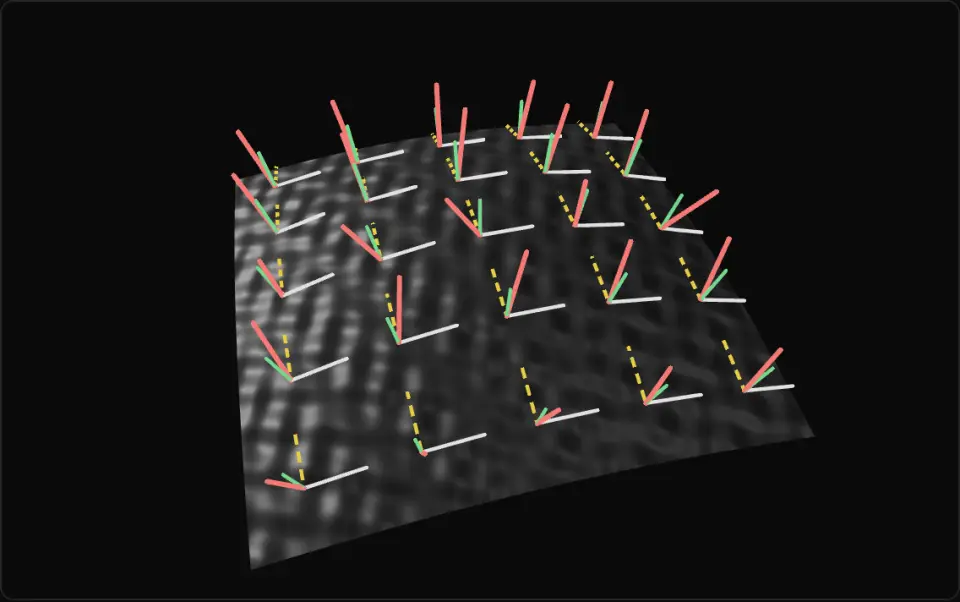
A smooth curved patch with a grid of frames: T is a solid white line along +U, B a dashed yellow line along +V, N a short solid green line, and the perturbed normal a long, thicker red line. Turn the normal map off and the detail vanishes because the geometry never changed; raise the strength and the red lines lean further from the green ones.
What it is
A normal map stores directions, but directions relative to what? If it stored world-space vectors, rotating the mesh would leave the lighting behind, and the map would fit only one object. So it stores them relative to the surface: (0, 0, 1) means "straight out" wherever the texel lands. Each surface point needs its own local axes to make sense of that, and that set of axes is tangent space.
The axes come from the UVs and the normal. The tangent T points where U increases, the bitangent B points where V increases, and N points out. Sample the map, turn rgb into rgb * 2 - 1, and the matrix [T B N] gives a direction in whichever space T, B and N are in. Rotate the mesh and T, B and N turn with it, so the detail stays attached. The same map can tile, go on another mesh, or sit on a skinned character.
T and B of a triangle come from its edges and UV deltas: two edge equations with two unknowns. Per-vertex tangents average those results, so they drift off perpendicular to the smooth normal. Gram-Schmidt fixes T, subtracting its component along N with a dot product, then B is rebuilt as a cross product.
That cross product only ever produces one handedness, but mirrored UVs (a character's left arm reusing the right arm's texels) need the other. So tangents are stored as a vec4, and tangent.w is +1 or -1: B = w * cross(N, T). In Three.js, BufferGeometry.computeTangents() writes exactly this attribute. It needs an index plus position, normal and uv, and MeshStandardMaterial uses the attribute as soon as you set a normalMap.
- tangent
- bitangent
- tbn
- normal map
- handedness
- uv
Key formulas
Rules of thumb
- A flat texel is about
(128, 128, 255): it decodes to roughly(0, 0, 1), so the lit normal is N. - Load normal maps as data, with
colorSpace = THREE.NoColorSpace. Decoding them as sRGB skews every direction. - Three.js expects +Y (green up) maps. For a -Y map, set
material.normalScale.y = -1. - Start
normalScaleat(1, 1). Values past about 2 look noisy and tilt normals away from the viewer. - Without a
tangentattribute, Three.js derives the frame from screen-space derivatives, which works but has faceted frames and can differ from the baker's result. - Re-normalize T and N in the fragment shader: interpolated unit vectors get shorter.
Implementation
const geometry = new THREE.TorusGeometry(1, 0.35, 32, 96) // indexed, has normal + uvgeometry.computeTangents() // adds vec4 "tangent": xyz plus w = handedness
const normalMap = new THREE.TextureLoader().load("/textures/stone_normal.png")normalMap.wrapS = normalMap.wrapT = THREE.RepeatWrappingconst material = new THREE.MeshStandardMaterial({  normalMap,  normalScale: new THREE.Vector2(1, 1),})scene.add(new THREE.Mesh(geometry, material))
// Non-indexed geometry (IcosahedronGeometry, for one) must be welded first:// const indexed = BufferGeometryUtils.mergeVertices(geometry)
const e1 = new THREE.Vector3(), e2 = new THREE.Vector3()function triangleTangent( p0: THREE.Vector3, p1: THREE.Vector3, p2: THREE.Vector3, uv0: THREE.Vector2, uv1: THREE.Vector2, uv2: THREE.Vector2, outT: THREE.Vector3, outB: THREE.Vector3,) { e1.subVectors(p1, p0); e2.subVectors(p2, p0) const du1 = uv1.x - uv0.x, dv1 = uv1.y - uv0.y const du2 = uv2.x - uv0.x, dv2 = uv2.y - uv0.y const d = du1 * dv2 - du2 * dv1 if (Math.abs(d) < 1e-12) return false // no area in UV space outT.copy(e1).multiplyScalar(dv2).addScaledVector(e2, -dv1).divideScalar(d).normalize() outB.copy(e2).multiplyScalar(du1).addScaledVector(e1, -du2).divideScalar(d).normalize() return true}// Vertexattribute vec4 tangent; // ShaderMaterial does not declare this one for youvarying vec2 vUv; varying vec3 vN; varying vec3 vT; varying float vW;void main() { vUv = uv; vN = mat3(modelMatrix) * normal; vT = mat3(modelMatrix) * tangent.xyz; vW = tangent.w; gl_Position = projectionMatrix * modelViewMatrix * vec4(position, 1.0);}
// Fragmentuniform sampler2D map; // the normal mapvarying vec2 vUv; varying vec3 vN; varying vec3 vT; varying float vW;void main() { vec3 N = normalize(vN); vec3 T = normalize(vT - N * dot(N, vT)); // Gram-Schmidt vec3 B = cross(N, T) * vW; // handedness vec3 s = texture2D(map, vUv).rgb * 2.0 - 1.0; vec3 worldNormal = normalize(mat3(T, B, N) * s); gl_FragColor = vec4(worldNormal * 0.5 + 0.5, 1.0); // debug view}Common mistakes
- Calling
computeTangents()on non-indexed geometry, or before normals and UVs exist. It logs an error, adds nothing, and the material falls back to derivatives. RunmergeVerticesorcomputeVertexNormalsfirst. - Dropping
tangent.wand always usingcross(N, T). Mirrored islands then light backwards, with bumps turning into dents. - Editing positions or normals and keeping the old tangents. Recompute them whenever the surface or its UVs change.
- Transforming T with the normal matrix. T lies along the surface, so it takes the model matrix, while N takes the inverse transpose.
- Baking a map against one tangent basis and rendering with another, which shows up as seams and pinched shading on low-poly meshes. Match the baker;
BufferGeometryUtils.computeMikkTSpaceTangentscovers bakers using MikkTSpace.
Prompt
# Tangent Space and the TBN Basis
- In TypeScript, write `triangleTangents(p0, p1, p2, uv0, uv1, uv2)` that returns unit tangent and bitangent vectors by solving E1 = du1*T + dv1*B and E2 = du2*T + dv2*B, returning null when the UV determinant is near zero.- Add `orthogonalize(t, n)` (Gram-Schmidt), `handedness(n, t, b)` returning -1 when dot(cross(n, t), b) < 0 and +1 otherwise, and `tangentToWorld(sample, t, b, n)` returning the normalized x*T + y*B + z*N.- Use plain [x, y, z] tuples.- Add a Vitest suite: a unit triangle with matching UVs gives T = +X and B = +Y; mirroring U gives handedness -1 and matches the `tangent` attribute written by Three.js BufferGeometry.computeTangents() on the same indexed triangle; frames from a skewed triangle and a tilted normal are orthonormal to 1e-6; the sample (0, 0, 1) always returns N.
In learning paths
Related
Further reading
Updated 2026-11-02
