MathematicsInterpolationcore4 min read
Lerp and Smoothstep
blend between two values, then make the blend feel good
Lerp blends two values by t, inverse lerp finds t, remap chains both. Smoothstep softens the ends, and exponential damping chases a target at any frame rate.
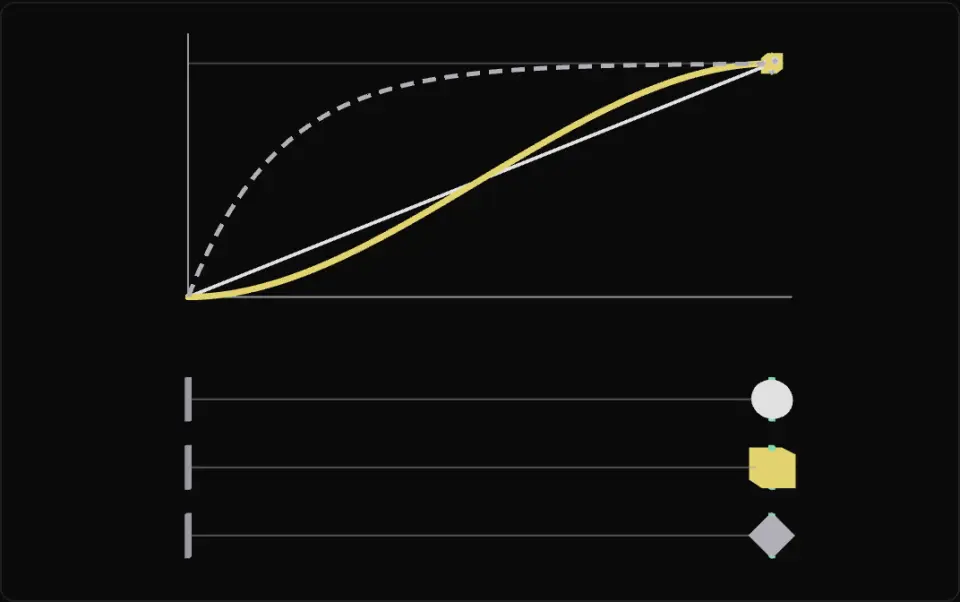
Three markers travel from the grey post A to the green post B. The white sphere lerps at constant speed; the yellow cube follows smoothstep and eases in and out; the grey diamond uses exponential damping, rushing off and then crawling, and never quite arriving. The plot above shows the same three curves: thin white straight line, thick yellow S-curve, grey dashed curve. Raise λ to make damping snappier, or switch to smootherstep.
What it is
Lerp (linear interpolation) blends from a to b by a fraction t: a + (b − a)·t. At t = 0 you get a, at t = 1 you get b, and anything outside [0, 1] extrapolates. It works on numbers, colours, and component-wise on vectors (Vector3.lerp). Inverse lerp answers the opposite question: where does v sit between a and b, as a 0..1 fraction? Chain the two and you get remap, which converts any range to any other: health 0..100 to a bar width, speed to engine pitch, height to fog density. Clamp the fraction when the output must stay in range.
Linear blends start and stop abruptly. Smoothstep runs t through 3t² − 2t³, which has zero slope at both ends, so a fade or move eases in and out. Smootherstep (6t⁵ − 15t⁴ + 10t³) also has zero curvature at the ends, which matters for camera moves and noise. Both take two edges and clamp, which makes them handy soft thresholds in shaders: smoothstep(0.4, 0.6, d) is a step with a soft border. For more curve shapes see easing functions.
A common trap is pos = lerp(pos, target, 0.1) every frame. It does smooth out motion, but it closes 10% of the gap per frame, so the game is twice as snappy at 120 fps as at 60. The fix is exponential damping: use t = 1 − e^(−λ·dt) with the frame's delta time. Now the same fraction of the gap closes per second at any frame rate. It never quite arrives, so snap when close enough.
- lerp
- inverse lerp
- remap
- clamp
- smoothstep
- damping
- interpolation
Key formulas
- Lerp and inverse lerp
- Remap
Maps [a, b] onto [c, d]; clamp the inner fraction to keep the output in range.
- Smoothstep and smootherstep
- Frame-rate-independent damping
λ = −ln(1 − fraction) / seconds: λ ≈ 4.6 closes 99% of the gap in 1 s.
Rules of thumb
- Camera follow: λ ≈ 5–10 /s feels tight, 2–4 /s feels floaty. λ = 4.6 closes 99% of the gap in one second.
- Snap when within a small epsilon (e.g. 0.001 units or 0.1°) so damped values actually reach their target and stop dirtying state.
- Fixed-duration moves (a door opening in 0.4 s) use lerp + smoothstep of
elapsed / duration. Moving or unknown targets use damping. - Clamp t before
lerpwhen overshoot would be a bug (health bars, alpha). Leave it unclamped when extrapolation is wanted. - In GLSL,
mixis lerp andsmoothstepis built in, with the same argument order:smoothstep(edge0, edge1, x).
Implementation
const lerp = (a: number, b: number, t: number) => a + (b - a) * tconst invLerp = (a: number, b: number, v: number) => (a === b ? 0 : (v - a) / (b - a))const clamp01 = (t: number) => Math.min(1, Math.max(0, t))const remap = (v: number, a: number, b: number, c: number, d: number) =>  lerp(c, d, clamp01(invLerp(a, b, v)))const smoothstep = (e0: number, e1: number, x: number) => {  const t = clamp01(invLerp(e0, e1, x))  return t * t * (3 - 2 * t)}
// Fog thins with altitude; vignette fades in between 30% and 10% health.scene.fog.density = remap(camera.position.y, 2, 40, 0.05, 0.005)vignette.opacity = 1 - smoothstep(0.1, 0.3, hp / maxHp)
// Camera chases the player at the same speed at 30, 60 or 144 fps.const LAMBDA = 6function follow(dt: number) {  camera.position.lerp(goal, 1 - Math.exp(-LAMBDA * dt))}
Common mistakes
x = lerp(x, target, 0.1)per frame without dt: speed depends on frame rate.- Lerping from the current value while also stepping
tfrom 0 to 1 over time. That double-eases and finishes early; lerp from the stored start value instead. - Swapping smoothstep's argument order, or passing equal edges, which divides by zero (guard it).
- Lerping angles or rotations component-wise. Wrap angles first, and use slerp for quaternions.
Prompt
Write `src/lib/interp.ts` in TypeScript with pure functions: `clamp(x, min, max)`, `lerp(a, b, t)` (unclamped), `inverseLerp(a, b, v)` returning 0 when a === b, `remap(v, inMin, inMax, outMin, outMax)`, `smoothstep(edge0, edge1, x)` and `smootherstep(edge0, edge1, x)` (both clamp t to [0, 1]), and `damp(current, target, lambda, dt)` = lerp(current, target, 1 - Math.exp(-lambda * dt)) plus `lambdaFor(fraction, seconds)`. Use them in a Three.js camera follow that damps position towards the player with lambda = lambdaFor(0.99, 0.4) using reused vectors, and a fog density that remaps the camera height from [2, 40] to [0.05, 0.005] with clamping. Write Vitest tests: lerp hits both endpoints; inverseLerp undoes lerp; remap is reversible; smoothstep is 0 and 1 at the edges, 0.5 in the middle and monotonic; damp gives the same result stepping 30 or 144 times over one second.In learning paths
Related
Further reading
Updated 2026-11-01