Impulse and Momentum
forces act over time, impulses act right now
A force changes velocity over time; an impulse changes it at once. The collision impulse conserves momentum and sets how much energy a hit loses.
core4 min read
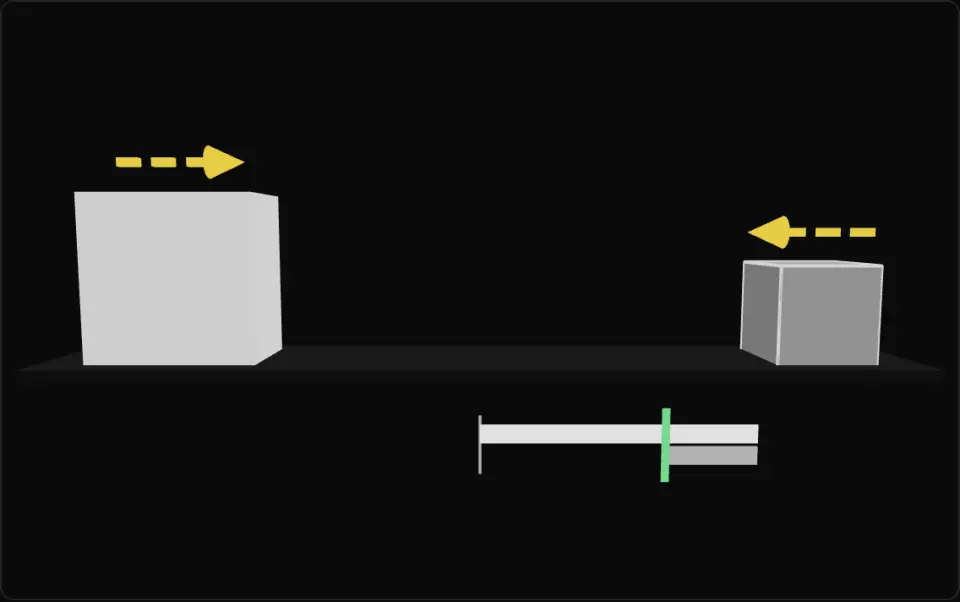
Two blocks collide head-on, with face area proportional to mass: A is white and B is grey with a light outline. Dashed yellow arrows are velocities, and the brief solid red arrows are the equal and opposite impulse at contact. Under the track, A's white bar and B's grey bar are their momenta, chained end to end, so the green tick marks the total and stays still through the hit. Change the masses, restitution and speed; the readout compares momentum before and after and shows the kinetic energy lost.
What it is
Momentum is mass times velocity, p = mv: how much it takes to stop something. A force changes momentum gradually, so you apply it every physics step and scale it by dt. An impulse is that same change delivered all at once, J = FΔt = Δp, so you apply it once and the velocity jumps by J/m with no dt involved.
Use a force for anything sustained: thrust, wind, gravity, drag. Use an impulse for anything that is over within a step: jumps, explosions, weapon hits, collisions. A real collision does involve a huge force over a few milliseconds, but a game step is far longer than that, so only the resulting FΔt is worth modelling.
In a collision, each body gets the same impulse in opposite directions along the contact normal, so total momentum cannot change. The size of that impulse comes from restitution e, the fraction of closing speed that returns as separating speed: 0 means the bodies move together afterwards, 1 means no kinetic energy is lost.
Static objects fit the same formula with an inverse mass of 0, which is why engines store 1/m rather than m: the wall takes none of the impulse, and no special case is needed. Hit a body off-centre and that impulse also spins it, which is covered in rigid-body dynamics.
- collision
- momentum
- impulse
- restitution
- physics
Key formulas
Rules of thumb
- Starting restitution:
0for characters and mud,0.1–0.3for crates,0.4–0.6for wood or hard balls,0.8–0.9for rubber balls. - Set
eto 0 when the closing speed is below about0.5–1 m/s, or resting objects will jitter instead of settling. - Jump impulse for a target height:
J = m·sqrt(2gh). Atm = 70,g = 9.81,h = 1.2that is about340 N·s. - Explosion: push each body along the direction away from the blast, with
Jfalling off to 0 at the radius. Linear falloff is a fine start. - Two bodies with the same
eare easy. When they differ, takingmax(e1, e2)keeps a bouncy ball bouncy on any floor.
Implementation
import * as THREE from "three"
export interface Body {  velocity: THREE.Vector3  invMass: number // 1 / mass, or 0 for static}
const rel = new THREE.Vector3()
/** n is the unit contact normal from a to b. Returns the impulse j. */export function resolveContact(a: Body, b: Body, n: THREE.Vector3, e: number) { const invSum = a.invMass + b.invMass if (invSum === 0) return 0 const vn = rel.subVectors(b.velocity, a.velocity).dot(n) if (vn >= 0) return 0 // already separating const j = (-(1 + e) * vn) / invSum a.velocity.addScaledVector(n, -j * a.invMass) b.velocity.addScaledVector(n, j * b.invMass) return j}import type { Vector3 } from "three"import type { Body } from "./resolve-contact"
// Each fixed step while the thrust or wind lasts.export function applyForce(b: Body, force: Vector3, dt: number) { b.velocity.addScaledVector(force, b.invMass * dt)}
// Once, on the frame of the jump, hit or blast.export function applyImpulse(b: Body, impulse: Vector3) { b.velocity.addScaledVector(impulse, b.invMass)}Common mistakes
- Multiplying an impulse by
dt, or applying a force once without it. A jump tuned this way changes with the frame rate, or barely moves at all. - Resolving contacts that are already separating. Without the
vn >= 0check, overlapping bodies that are moving apart get pulled back together. - Flipping the normal. With
nfrom a to b,alosesj·nandbgains it; swap either one and objects accelerate into each other. - Dividing by mass on static objects. Store inverse mass, so a wall is
0and two walls can be skipped instead of dividing by zero. - Expecting this to stop overlap. An impulse only changes velocity, so positions still need separate correction, and fast bodies can skip contact entirely: see tunneling.
Prompt
# Impulse and Momentum
- Implement collision response for two bodies in TypeScript with Three.js.- Each body has a THREE.Vector3 velocity and an invMass number, where invMass 0 means static.- Write resolveContact(a, b, n, e), with n the unit contact normal pointing from a to b and e the restitution in [0, 1].- Compute vn = (b.velocity − a.velocity)·n.- Return 0 without changing anything if vn ≥ 0 or if both inverse masses are 0. Otherwise compute j = −(1 + e)·vn / (a.invMass + b.invMass), subtract j·a.invMass·n from a.velocity, add j·b.invMass·n to b.velocity, and return j.- Do not allocate per call, and do not handle rotation or friction.- Write unit tests with random masses checking that momentum is conserved, that e = 1 conserves kinetic energy, that e = 0 gives equal normal velocities, that a static body never moves, and that a second call on the same contact returns 0.
In learning paths
Related
Further reading
Updated 2026-11-02
